
- The Cuban countryside east of Havana.
A trip to Cuba has been on my bucket list since before there were bucket lists, and now that I’ve gone, I can’t wait to go back. I never wanted to test my luck with sneaking in via Mexico or Canada, but the pull was strong. So the second Obama said “Go” — we went.
It’s a completely different world, Cuba. It’s old cars, bad gasoline, crumbling buildings and there’s never any toilet paper after 2pm or so. But despite the ruin around them, the people are some of the happiest I’ve ever met. You’ll never not hear music playing. The food is incredible, and I’ve never felt so welcome as a foreigner in another land.
My husband and I went alone and tried to stay off the beaten path as much as possible in order to really get to know the Cuban way of life. We are both former journalists so we just did our research, read a bunch of books and blog posts, and went for it. I’m sure there are guided excursions, pre-planned itineraries and such if you search for them, but you won’t find any of that here. Plus, Americans doing touristy things is still technically illegal, so our itinerary was intended to immerse us in the culture.
This post will focus on the basics, and need-to-knows before making your trek.
What to Bring
Money
Getting There
Lodging
Getting Around
Tech
Language
What to Bring
Let’s start with a packing list. You’ll have to bring a lot more with you than you usually do, because you never know if they’ll have rations. Specifically, toilet paper. We were lucky if we found a toilet that actually had the seat on it and/or flushed, much less one with toilet paper, so I always carried a travel pack of adult wet wipes in my purse. Also:
- Any over-the-counter medications along with your prescription — especially anti-diarrheal, gas, tums, etc. Remember that it is a third-world country.
- An outlet converter (some places take US, some do not)
- Sunscreen. If you buy it there, you’ll pay $20 and up for a small bottle
- Bug spray. Because, see above. Also, zika.
- Ladies – bring bike shorts. Wear them under your sundresses, because you’ll be doing a lot of walking, and walking in the tropics = chafing. Just trust me on this one.
- Old-school, paper-based guidebooks and maps, or download info onto your phone so you can access it offline because wifi is scarce and using data will send you to bankruptcy court. The book that we found most helpful was Real Havana — it led us to some tremendously delicious (and cheap) restaurants and clubs.
- Cash. As of this writing, US credit cards aren’t accepted in Cuba. Which brings me to…
Money
There are two local currencies in Cuba, the moneda nacional (mn) which is what the locals use, and the CUC, (pronounced kook) which is the tourist currency and basically equivalent to the USD. If you exchange directly from USD to CUC, though, you’ll pay a 10% surcharge on top of the exchange rate. To avoid that, you may want to consider exchanging your U.S. dollars for another currency (euros, Canadian dollars, etc.) before entering Cuba.
If you dig around to find the cheaper restaurants (more on that later) and walk more than you take a taxi, you can get by on a relatively small budget. You can expect to pay anywhere from full-on American prices at some of the touristy restaurants, to as little as a few mn for a sandwich at one of the many (many) street side vendors. We also used Airbnb for our stay in Havana, which cost us about $85 a night.
TIP: You can only exchange money in the hotels if you are a guest. Otherwise, you have to find a cadeca, which can be a challenge on the winding streets of Old Town. The lines are long and you’ll need your passport, but you may be able to find someone standing outside the office who can exchange it for you at a better rate. We discovered this when we (finally) found a cadeca, only to learn that it was closed because they were spraying for Zika with some sort of crazy metal contraption that looked like it was straight out of 1955.
TIP: There’s a cadeca in the basement of the Focsa building, which is this giant blue structure that serves as a landmark for the Vedado neighborhood. Also a few stores there and a cafe or two.
Getting There
When we traveled in May 2016, there still weren’t direct flights from America to Havana, so we went the Mexico City route. This is changing, though, and those of you who get to fly directly from the U.S. to Havana — your travel is going to be a lot easier than ours was.
We didn’t have any issues connecting through Mexico City necessarily, but we used every single minute of our 4 hour layover to get through customs and figure out where we needed to go. There were huge lines in Havana to check in for our return flight as well, so allow yourself plenty of travel time. And travel light if you can — we took only backpacks and I was very glad we did.
No matter which country is your gateway, though, you’ll need to get a Cuban tourist visa at the airport terminal before you get on your flight. Keep it, along with your passport, with you AT ALL TIMES when you’re in Cuba. (You’ll need your passport to exchange money). You’ll surrender it when you leave, so be sure to take a photo for a keepsake. In addition, hold back some CUC so you can pay for your exit visa on the way out. (Check the interwebz for the latest on the price, as it seems to keep changing.)
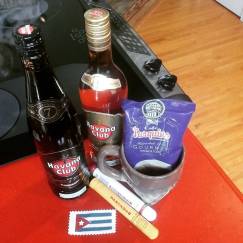
TIP: Finally, this might be the MOST IMPORTANT TIP OF YOUR LIFE EVER for international travel. If you want to bring home alcohol but aren’t comfortable putting glass bottles into your checked luggage, buy it in the duty-free shop at the airport and have them seal it into an official duty free bag. YOU CAN TAKE IT THROUGH SECURITY WITH YOU THAT WAY**. They just unseal the bag, test the bottles and seal the bag back up. I’m using all caps here because alcohol is important, people. #priorities
**A logistical note, in case you’re reading this post far in the future: We were not allowed to bring rum out of Havana because of the embargo. Instead, we bought it at the duty-free shop in Mexico City and brought it home from there. Do some research to see what the latest restrictions (or lack thereof) are, because as I write this things are changing.

There are two options for lodging on the island – hotel, or casa particular. The hotels in Havana are government-run and very beautiful. They are what most foreign tourists see, so the government puts a lot of effort into making sure they are sprawling and grand (and pricey.) We didn’t stay in a hotel, but we did spend quite a bit of time at Hotel Nacional de Cuba. Its back patio is my pre-trip vision of Havana come to life, with live music, tropical breezes and lots of guyabaras. They also serve a mean mojito. (Wifi there was around $6 an hour.)

Your other, vastly cheaper option, is to stay in a casa particular, which we booked via airbnb.com. Renting out rooms or apartments is one of the few capitalist-ish ways that Cubans can make money for themselves, so it seemed like every other door had a “for rent” sign on it. We stayed here with an awesome man named Yoan, who helped us arrange everything from a ride at the airport to breakfast with his upstairs neighbor every morning. It was a great way to support the Cuban people, and what better way to get to know the locals than to live in their apartment building for a few days?
Getting Around
One of the things that makes Cuba so other from the U.S. is that hitchhiking is a state-sanctioned activity. So, if all else fails, just stick your thumb out and ask for a ride. If you’re not quite ready for that adventure, operating a taxi particular is also one of the other ways that Cubans are allowed to make a business for themselves, so pretty much everyone is a taxi driver, and every car is a taxi.
We used a combination of walking and taxis to get around, along with one terrifying ride in a coco taxi that’s a story we’ll tell for a while. My best piece of advice? Keep your arms and legs inside the vehicle at all times. Don’t even stick your toes out over the edge.
Walking is a great way to experience Havana, and we did a lot of it. Up and down La Rampa (Calle 23), along the Malecón, around Old Town … it’s by far the best way to see life in the city. It’s not always easy — the streets are winding and not well marked beyond a low concrete post on the corner — but it’s by far the best for exploring, and it’s completely safe, everywhere, all the time. We were out until the wee hours of the morning and the streets were filled with people, but we never felt unsafe. The only time we were ever stopped, it was by a group of boisterous Cubans who wanted to buy us beer and talk about the U.S. (OOSA!) It was nothing like walking in a big city at night in America, and it was pretty awesome.
If you need to go farther than a walk can take you, the key to local transportation is that everything is negotiable, and the initial prices vary widely. Sometimes we were able to get a lift for 1 or 2 CUC, and other times we paid as much as what we’d expect to pay in any other large city. The cars range from breathtaking, 1950’s-era American classics to boxy, foul-smelling Russian jalopies that look like they’ll fall apart at any second.
If you want to leave Havana to explore the countryside and other regions of the island, you can take the Viazul bus, which is very affordable. Buy your tickets in advance, though. They sell out. Otherwise, you can find a taxi particular outside of any of the major hotels, or arrange a private ride.
Tech
Most of the major U.S. cell phone carriers offer international calling plans for Cuba, and calls to the U.S. are around $2 a minute. That’s not bad, and worth it to call the kids every night. The data, though, will eat you alive. You know it’s a bad idea when even Sprint is strongly advising you to turn off all cellular data while you’re there. We turned off cellular data AND put our phones on airplane mode just to be safe.
Your best option if you need to connect is to go to one of the hotels and buy 30 minutes or an hour of wifi. It will cost you no more than 10 CUC, and the signals are pretty good. Otherwise, take advantage of the opportunity to disconnect. It’s pretty liberating. (Imagine what America would be like if we had to go to a hotel and pay $10 an hour for internet.)
Language
This is probably the part where I’ll lose some of you, but you have to know some Spanish to have a good experience in Cuba. This is not like Spain or Mexico, where everyone is taught English from childhood. While they do speak more English in the tourist areas, the locals are only taught the very basics in school, like how to say hello, goodbye, thank you and give someone their address. Those who speak more than that are self-taught.
I never studied Spanish in school, so I bought Pimsleur’s audio-based lessons and practiced in my car, and it worked like a charm. There’s also Learn in Your Car Spanish, which I used for a trip to Costa Rica a few years back. If nothing else, be able to say and understand numbers so you can negotiate with the cab drivers. “Donde esta…” (Where is…) is very helpful, too, along with “Cuanto cuesta?” (How much does it cost?)
Then, to make things even more challenging, Cuban Spanish sounds nothing like what you’ll hear on your audio tapes. They don’t pronounce s’s at the end of words … or in the middle of words … or articulate any hard consonants, really. Muchas gracias is more like “mucharacia.” Dos dias is more like “dodia.” It can throw you at first, but once you figure out that there should be a consonant in there somewhere, it gets a lot easier to understand. And, you can always politely say “Hablas mas largo, por favor.” (Speak more slowly, please.)
So, that’s the Cuba travel 101. Coming soon — more stories, more pictures, just more about this amazing country and its people.

 40 is the New F Word